On this page you will find these different categories. This is the start of a briefing overview of data centres and the concerns about them, for the Lane Cove West Community. Requested by Anthony Roberts, with special thanks to the Lane Cove Councillors and members of the Lane Cove Responsible Planning group for discussions and leads in putting this together. Artificial Intelligence, search engines, web pages, and academic papers, were used in generating this overview.
Data centres briefing summary
- Data Centre Overview
- Top 10 Countries
- Biggest Data Centre Firms
- hyperscale owners
- Benefits (Why They Matter)
- Backbone Engines of the Digital Economy
- Economic Investment
- Resilience
- Infrastructure Upgrades
- Communication
- Storage
- Computation
- Artificial Intelligence
- Industrial Systems
- Financial Markets
- Timeline
- 1940s–1950s: Machine Room Era
- 1960s–1970s: Corporate Computing Centres
- 1980s: Networked Expansion
- 1990s: Internet Boom
- 2000s: Cloud Era
- 2010s–Today: Hyperscale + AI
- Observation
- Data Centre Single Units vs Cluster Units
- Loudoun County
- Charlotte
- Texas
- West Haven
- Observation
- Concerns
- Resource Concerns
- Environmental Concerns
- Community Concerns
- Infrastructure Concerns
- Ecological Concerns
- Strategic Concerns
- Power and Water Usage
- Small Data Centres
- Medium Data Centres
- Large Hyperscale Facilities
- Lane Cove West Specific
- Interesting other stuff
Data Centre Overview
Data centres are the engine rooms of the digital world — the hidden infrastructure powering everything from cloud computing and AI to banking, schools, hospitals, and everyday communication. Current estimates put the world at roughly 11,000–12,000 operational data centres globally, depending on how “data centre” is defined (small enterprise rooms vs hyperscale campuses). They are spread across about 150–180 countries, but highly concentrated in a handful of nations.
Top countries right now:
- United States — 4,000+
- United Kingdom — 500
- Germany — 500
- China — 360
- France — 340
- Canada — 280
- India — 275
- Australia — 268
- Japan — 250
- Italy — 200
The biggest data centre firms are
- Equinix
- Digital Realty
- NTT Data
- CyrusOne
- Iron Mountain
- QTS Realty Trust
hyperscale owners include:
- Amazon Web Services
- Microsoft
- Meta Platforms
- Oracle Corporation
- Alibaba Group
Of the 11,000 data centres its estimated that 50,000 organisations operate within the data centre framework
Benefits (Why they matter)
Backbone engines of the digital economy
- Cloud services
- AI computation
- Banking systems
- Government systems
- Health records
- Education platforms
- Communications
- Defence systems
Economic investment
- High capital injection
- Construction jobs
- Specialist technical jobs
- Possible local business spin-offs
Resilience
- Redundancy across multiple sites
- Faster data access
- Better disaster recovery
- National data sovereignty
Infrastructure upgrades
- Fibre upgrades
- Substation upgrades
- New energy systems
- Potential battery integration
The data centre economy has an estimated turnover of around $Aud 650 billion.
Communication
The biggest category.
- Messaging
- Social media
- Video calls
- Streaming
- Website hosting
Examples:
Meta Platforms, Google, Zoom Video Communications
Storage
Digital memory of the world.
- Photos
- Documents
- Backups
- Archives
- Medical records
- Government records
Examples:
Dropbox, Google
Computation
Heavy mathematical processing.
- Banking transactions
- Scientific modelling
- Weather forecasting
- Engineering simulations
- Rendering
- Cryptocurrency validation
Examples:
Visa Inc., European Centre for Medium-Range Weather Forecasts
Artificial Intelligence
Fastest-growing load.
- AI model training
- AI inference
- Image generation
- Voice processing
- Recommendation engines
- Autonomous systems
Examples:
OpenAI, NVIDIA
Industrial Systems
The hidden backbone.
- Power grids
- Traffic systems
- Hospitals
- Logistics
- Supply chains
- Factory automation
Examples: Siemens
Financial Markets
Ultra-sensitive, ultra-fast.
- Stock trades
- Currency exchange
- Insurance systems
- Fraud detection
- ATM networks
Examples:
NASDAQ, Mastercard
Timeline
1940s–1950s: The Machine Room Era
The first true predecessors of data centres appeared with early mainframe computers like IBM systems. These were huge, room-sized machines needing dedicated cooling, power, and security.
1960s–1970s: Corporate Computing Centres
Banks, governments, universities, and defence built dedicated computer rooms for processing payroll, records, and communications.
1980s: Networked Expansion
As business computing expanded, “server rooms” became common. More organisations began hosting their own digital systems.
1990s: The Internet Boom
This is when the modern data centre really took shape. The rise of websites, email, and e-commerce created demand for large hosting facilities.
2000s: Cloud Era
Companies like Amazon Web Services, Google, and Microsoft scaled data centres into global infrastructure.
2010s–Today: Hyperscale + AI
Massive campuses emerged, often with dozens of buildings in one precinct, designed to support:
- cloud storage
- streaming
- AI training
- financial systems
- global communications
Observation
“While data centres have existed since the 1940s, their scale, density, and resource intensity have increased dramatically over the past 20 years, transforming them from isolated technical facilities into major industrial infrastructure.
Data Centre single verse clusters
“A single data centre is broadly comparable to other major industrial or commercial buildings, with impacts that can often be managed within existing planning and infrastructure systems. Similar footprints may be seen in hospitals, warehouses, shopping centres, or manufacturing sites. The difference arises when multiple data centres cluster together. At that point, they begin to operate as a concentrated industrial ecosystem, where cumulative demands on electricity, water, roads, and emergency services can exceed normal planning assumptions. This can trigger changes in governance, zoning, utility prioritisation, and public infrastructure investment — shifting costs and pressures onto local communities through upgraded substations, roadworks, water systems, and altered land-use priorities.”
Loudoun County
- Planning laws tightened — no longer “by-right” in many zones; now public hearings are required.
- Power transmission upgrades costing billions.
- New high-voltage corridors reshaping land use.
- Residential tax structures partially offset by data-centre revenue.
- Growing public opposition over noise, views, and land conversion.
Charlotte
- City imposed a 150-day moratorium on new data centres to rewrite planning rules.
- Reviewing:
- water usage
- zoning buffers
- noise limits
- energy demand
Texas
- Proposed “bring your own electricity” model.
- New rules that data-centre operators fund their own grid expansions.
- Review of tax exemptions.
West Haven
- Noise complaints
- community health concerns
- lack of specific zoning laws.
Observation
Internationally, major data-centre regions show a clear pattern: once clustering reaches critical scale, governments often shift from passive approval to active regulation, introducing new zoning controls, infrastructure levies, moratoriums, and utility reforms in response to cumulative community and environmental pressures. Global climate change is measured as an average increase across the entire planet, often in fractions of a degree over long periods. By contrast, localised industrial heat zones — such as clustered data centres — can create temperature increases of several degrees within a much smaller area, over much shorter timeframes. While these are not equivalent in scale or cause, they can produce similar local effects on human comfort, vegetation stress, and urban heat exposure.”
Concerns:
Resource Concerns
These relate to the direct physical resources required to build and operate data centres, and how concentrated demand may place pressure on local and regional supply systems.
- Power demand — massive draw on local electricity grids
- Water consumption — cooling systems can use millions of litres
- Land use — large industrial footprints replacing other land uses
- Construction materials — concrete, steel, rare metals
Environmental Concerns
These relate to the effects data centres may have on the surrounding natural environment, including heat, air, water, noise, and ecological balance, particularly when clustered together.
- Heat island effects — concentrated waste heat raising local temperatures
- Thermal discharge — hot air and water affecting nearby ecosystems
- Carbon emissions — especially if powered by fossil fuels
- Noise pollution — fans, chillers, generators running continuously
- Light pollution — 24/7 security and operational lighting
- Air quality risks — diesel backup generators and maintenance emissions
- Water quality — what condition does the water leave the site
- Firewater contamination — In the event of a battery or electrical fire, contaminated runoff may enter stormwater systems or nearby waterways such as the Lane Cove River.
- Flood resilience — Facilities near waterways may face increased flood risk, runoff management pressures, and downstream environmental consequences.
- Fuel storage risk — On-site diesel reserves for emergency generators may introduce spill, fire, and air pollution risks.
Community Concerns
These relate to how data centres may affect the daily lives of nearby residents, businesses, and public spaces through changes in traffic, noise, land use, and local amenity.
- Traffic congestion — construction and service vehicles
- Visual impact — large industrial buildings changing landscape character
- Property value shifts — uncertain impacts on nearby homes/businesses
- Loss of green space — reduction in bushland, trees, open land
- Sport and recreation impacts — hotter surrounding zones affecting outdoor activity
- Land-use displacement — High-demand industrial zoning may reduce future opportunities for mixed employment, community uses, or greener industries.
- School heat exposure — Increased localised thermal load may affect nearby school environments, playground use, and outdoor learning conditions.
- Access constraints — Limited road access may affect emergency response, evacuation capacity, and congestion during incidents.
- Precedent effect — Approval of one clustered industrial type may encourage further high-intensity developments, compounding long-term precinct pressures.
Infrastructure Concerns
These relate to the capacity and resilience of public systems needed to support data centres, including electricity, water, roads, communications, and emergency services.
- Grid instability — large sudden loads affecting wider networks
- Water infrastructure strain — competing with residential needs
- Road wear — heavy equipment transport
- Emergency risks — fire, battery storage, fuel systems
Ecological Concerns
These relate to the impacts data centres may have on local ecosystems, biodiversity, vegetation, wildlife habitats, and natural environmental cycles.
- Habitat disruption — impacts on native species
- Tree stress — heat and soil changes
- Ground temperature rise — affecting vegetation and insects
- Stormwater changes — increased hard surfaces affecting runoff
- Increased vibration — disrupting animal’s behaviours and sleep patterns.
Strategic Concerns
These relate to the long-term planning, security, economic balance, and regional resilience issues that arise when critical digital infrastructure becomes concentrated in one location.
- Concentration risk — too much digital infrastructure in one place
- Security target — cyber and physical vulnerability
- Economic imbalance — high resource use with low direct employment
- Lifecycle risk — Rapid technological change may shorten facility relevance, creating future retrofit, expansion, or decommissioning pressures.
Power and Water Usage
Small Data Centre (Enterprise / local)
Typical IT load: 500 kW – 2 MW
Annual electricity:
- 500 kW continuous = 4.38 million kWh/year
- 2 MW continuous = 17.5 million kWh/year
Water (cooling dependent):
- roughly 5–20 million litres/year
Comparable to:
- ~800–3,500 Australian homes in electricity.
Medium Data Centre (Commercial / Colo)
Typical IT load: 5 MW – 20 MW
Annual electricity:
- 5 MW = 43.8 million kWh/year
- 20 MW = 175 million kWh/year
Water:
- roughly 25–150 million litres/year
Comparable to:
- a small suburb.
Large Hyperscale Facility
Typical IT load: 50 MW – 150 MW
Annual electricity:
- 50 MW = 438 million kWh/year
- 150 MW = 1.314 billion kWh/year
Water:
- roughly 250 million – 1 billion litres/year
Comparable to:
- a regional city.
Lane Cove West Specific,
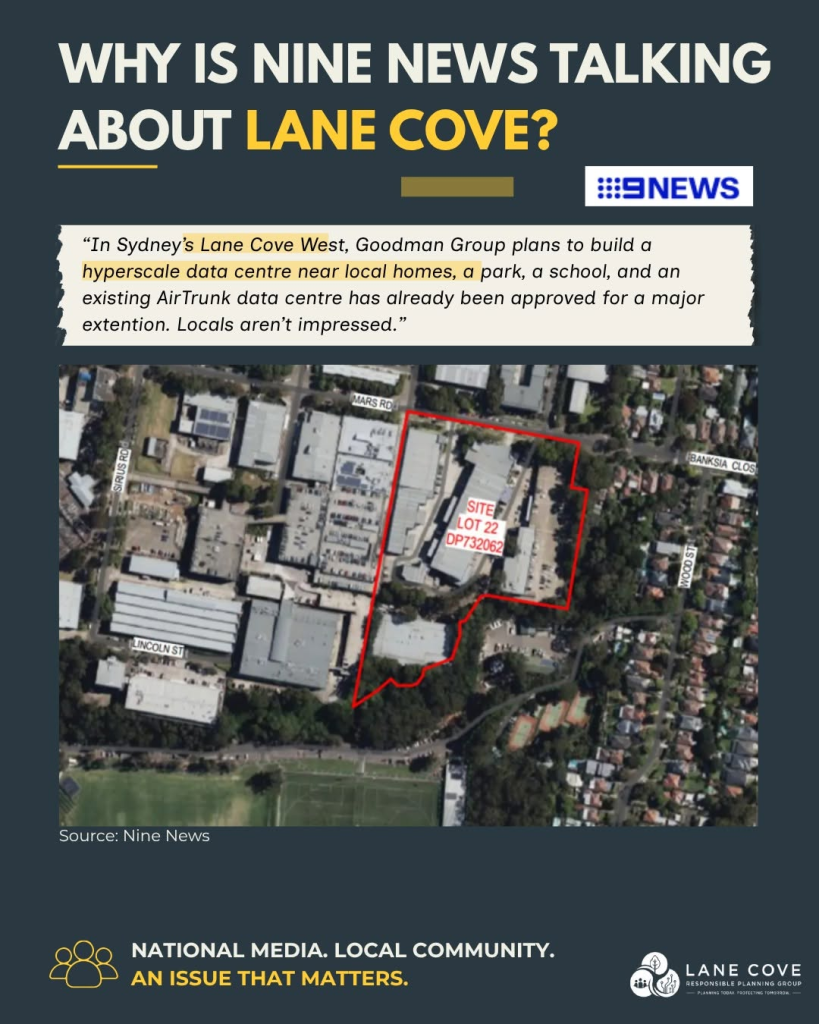
Lane Cove West presents a distinct environmental and community context for data centre development. The precinct is characterised by proximity to the Lane Cove River, significant native vegetation, bushland corridors, wildlife habitats, sporting fields, and a nearby junior public school. It is also bordered by established residential areas and existing low-rise industrial buildings. The area currently operates with a single primary road access point, legacy electricity infrastructure, and a limited water supply network. These characteristics mean that any concentration of high-demand industrial infrastructure may require careful assessment of cumulative impacts on environmental systems, public infrastructure capacity, emergency access, traffic movement, heat loading, and community amenity.
Interesting other stuff